Our monthly Employee Spotlight series gives you a glimpse behind the scenes and brings you closer to the people behind the products at Vispero. This month, we are honoring Matt Ater, a leader in accessibility services and customer-facing innovation at Vispero, whose work has helped expand how accessible technology shows up in the real world—from workplaces to kiosks. We sat down with Matt to reflect on his journey,
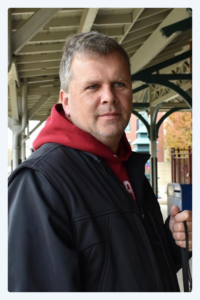
what drives him, and what he’s excited about next.
Tell us a little about yourself.
I’m Matt Ater, husband to my wife, Meryl, and dad to two daughters, Lexi and Riley (both in their 20s). We live in Manassas, Virginia, and I also have a dog named Riggly (spelled this way on purpose so screen readers pronounce it correctly). He’s a 75-pound red fox lab who still plays fetch like a puppy, and honestly, he’s one of my daily joys. Outside of work, I’m big on sports. Baseball is probably number one, and college football is right up there too. I went to the University of Alabama, where I met my wife, and I’m still a proud fan.
What’s your title and role at Vispero, and what does a typical day look like?
My day-to-day is a mix of supporting our sales team, building relationships across the industry, and helping Vispero find opportunities where accessibility can make a real impact. I’ve been in this space for decades, so a lot of what I do comes down to connecting dots (often quickly). I always tell people, “I don’t know everything, but I know a lot of people who do.” Relationships are everything in this industry. That’s how you find the right path into a new customer, a new segment, or a new partnership.
What brought you to Vispero?
My career started with training blind people around the country on assistive tech, back when a lot of it was pre-Windows, and you had to learn on the fly. I worked in nonprofits, led major federal accessibility efforts, and even spent time outside the assistive tech world to understand how enterprise technology really works—how software gets deployed, how infrastructure is managed, how organizations make decisions. In 2013, I reached out to the CEO of Freedom Scientific at the time with a simple idea: if you have hardware and software, you’ve got two legs of a stool…and a stool doesn’t stand on two legs. We needed a third leg: accessibility services. I joined in January 2014 to build a services business that didn’t exist yet, focused on being closer to customers and bringing real-world requirements back into the company. That work helped shape what has grown into today’s services and consulting efforts across Vispero.
What part of your job do you enjoy the most?
I love being out in the world with customers and with the broader industry, listening, learning, and helping create solutions that work for people who are blind or have low vision. I spend time with community and advocacy organizations, and I also work with industry leaders, where accessibility isn’t always top of mind—yet. Sometimes it’s as simple as having the right conversation at the right moment. I’ve met people in an elevator, chatted for 15 seconds, and uncovered a real accessibility need that turns into meaningful work. That’s the fun of it: accessibility is everywhere, and connection matters.
What’s something you’ve worked on recently that you’re proud of?
One of the biggest is the progress we’ve made with JAWS for Kiosk and accessible payment experiences. There are hundreds of thousands of devices now that allow blind people to independently do things like pay a bill, confirm the amount, understand the tip, and enter a PIN using speech output and accessible interfaces. That might sound simple to someone who’s never been blocked by a touchscreen payment device, but for those affected, it’s independence in a moment that used to be frustrating or impossible.
How does your work connect to Vispero’s mission?
At the end of the day, my work is about making life easier and better for people who are blind or low vision, whether that’s through the products themselves or through services that help organizations implement accessibility the right way. I’m also deeply passionate about employment access, because a paycheck is real independence. Technology that helps people succeed at work changes what’s possible—career growth, stability, travel, and choice. Vispero is uniquely positioned because we create the tools people use on the job, and that gives us an opportunity to move the needle in a big way.
What helps you do your best work each day?
Technology is a huge part of it. I use JAWS, ZoomText, and Fusion every day on my computer, and VoiceOver on my phone. I also use tools like smart glasses to read signs when I’m traveling, and services like Aira, which provides live, on-demand visual support through my phone’s camera, which is especially helpful in unfamiliar environments. These tools are more than products; they’re independence. Whether it’s navigating an airport, reading a sign, or even figuring out which bottle is shampoo in a hotel, the right tech helps me stay focused on what I’m there to do.
What’s something most people don’t know about you?
I lost my vision when I was six due to hydrocephalus (water on the brain). And while vision loss is always challenging, losing vision that young shaped my life differently than losing it later. I credit my parents a lot for not sheltering me. They pushed me to do the normal things other kids did: travel, try sports, and take opportunities. That belief in “you can do this” stuck with me. I also love skiing! There’s something about it that feels like freedom.
What motivates you—at work or in life?
At work, what motivates me most is seeing how what we do helps people succeed at school, at work, and in everyday life. Personally, it’s my family that motivates me. I’m also a big believer in paying it forward. I’ve had people reach out for mentorship and guidance, and when you’ve had opportunities, you should help others find theirs too.
What’s one thing you’re excited about right now?
I’m excited about what AI will continue to do for the blind and low-vision community. There’s a lot of debate about AI, but from what I’m seeing, the potential to improve daily life and independence is incredible, especially when it’s built thoughtfully with accessibility at the center.