Our monthly Employee Spotlight series gives you a glimpse behind the scenes and brings you closer to the people behind the products at Vispero. This month, we are spotlighting Roxana Fischer, Product Manager, Blind and Low Vision Software. We chatted with Roxana to find out how her accessibility journey started, what major turning point has shaped her career, and why everyone should know about screen-reading technology.
How long have you been with Vispero?
Roxana: I started with Freedom Scientific in 2019 in Florida. Since I previously lived in Germany, I moved to Florida for that opportunity. At the time, I was also completing my Master’s degree in Human-Computer Interaction, and I wanted to write my Master’s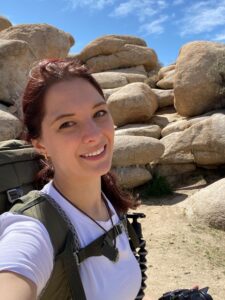 thesis in cooperation with Freedom Scientific, which I was able to do.
What was your title/role when you started, and what is it now?
R: I started as a UX Researcher, focusing on voice assistants for screen magnifiers, which aligned with the topic of my thesis. Today, I am a Product Manager for Fusion Suite, including JAWS, ZoomText, and Fusion.
What drew you to Vispero, and how has your journey with the company evolved over time?
R: During my Human-Computer Interaction studies, I felt that accessibility technology was not covered deeply enough, and I wanted to explore this field further through my thesis. I already knew Freedom Scientific from my previous work as an Assistive Technology Trainer and JAWS Scripter at Papenmeier, where I gained my experience in teaching JAWS, ZoomText, and Fusion, as well as scripting to ensure enterprise software was not only accessible, but also usable with screen readers and via the Braille displays. I’ve had the pleasure of meeting many of our customers and supporting their work across a wide range of industries, including lawyers, patent advisors, call centers, and many other professional office environments. What continues to fascinate me is how a digital world that is often so visually focused can also be experienced through speech, tactile feedback like Braille, and efficient keyboard navigation without a mouse.
Looking back at your career so far, what accomplishment are you most proud of?
R: I am most proud of the step I took, moving from being a trainer in Germany to joining Freedom Scientific/Vispero directly in the United States. At the time, I was not fully confident speaking English professionally, and I had never lived in another country. Making that move was both intimidating and uncertain, but I decided to apply anyway. That decision became a major turning point in my career. It allowed me to grow from training and supporting users into UX research and eventually into product management, where I can now help shape the direction of products like JAWS, ZoomText, and Fusion and contribute to their impact on users worldwide.
What’s one skill or perspective you’ve gained from working in the accessibility space?
R: One of the most important perspectives I’ve gained is how differently people can experience technology. Accessibility is not just a technical requirement; it fundamentally changes how we think about design, interaction, and inclusion. I also value that I can use our products myself. Even though I am not blind, I used JAWS during my studies to listen to documents, which significantly improved my learning and allowed me to stay focused.
What’s one piece of advice you’d give to someone new to the accessibility or assistive tech field?
R: My advice is to stay open, try things out, and learn directly from real users. I still clearly remember learning JAWS for the first time. As a sighted person, I was used to understanding software visually, so first adapting to the screen reader paradigm was a bit challenging. I initially clicked through every menu item, but because I was still focused on visual changes on the screen, it didn’t help much. Reading our documentation helped me shift my perspective and focus more on the auditory output. I also tried to fully immerse myself by covering my computer screen and practicing tasks like opening Word, writing a document, and saving it using only JAWS. However, my most valuable learning came when I started working with real users myself. In addition, as assistive technology trainers, we were encouraged not to take control of the user’s computer, but instead to provide guidance verbally. That experience showed me how essential clear communication and a deep understanding of different user perspectives are in accessibility work.
What’s your favorite aspect of our company culture?
R: My favorite aspect of Vispero’s culture is the strong sense of cooperation, shared motivation, and understanding. I’ve been impressed by how much people here care, not only about their own work, but about the team, the product, and its real impact on users’ lives. As a product manager, I notice and appreciate this commitment every day.
What’s an assistive technology product you think more people should know about?
R: I still think not enough people know about screen reader technology in general. Even today, the number of people I meet outside of our industry who have heard about screen readers is surprisingly limited. More people should understand that digital technology can be made accessible for users with visual impairments — and unfortunately, this still comes as a surprise to many.
What are you currently learning about (either professionally or personally)?
R: I finished a second master’s degree last year, which allowed me to explore different business areas connected to assistive technology and accessibility. One topic that especially interests me is the wide range of differences across Europe and the world in how people with disabilities are systematically supported, and how that affects access to assistive technology, hardware like Braille displays, and training.
What are you most passionate about outside of work?
R: My biggest personal passion is climbing, especially bouldering, which is a form of climbing done on shorter walls without ropes, focusing heavily on technique. Every weekend, I try to make time for a trip to the bouldering gym with my friends.
Do you have any hidden talents or unique hobbies? Share them with us!
R: My hidden talent is a work in progress. I’m training to hold a handstand for 10 seconds. I’m making good progress and hope to achieve it soon.
You have a time machine! Would you travel to the past or the future, and why?
R: I would choose the future. Humanity has always progressed by learning from setbacks and pushing boundaries. I would be fascinated to see how we grow as a global society and what breakthroughs will shape the coming years and centuries.